
Traditional clothing is one of the most widely recognized representations of a nation's culture and identity. This holds particularly true for a country as renowned for its economic and cultural development as Indonesia. So, what sets Indonesian traditional clothing apart and garners international acclaim? Let's explore in this article.
1. What Is Traditional Indonesian Clothing?
Traditional clothing serves as a symbol of a nation, reflecting its historical development and growth. In Southeast Asia, Indonesia, often referred to as the "archipelago nation" due to its many beautiful islands, stands out with its unique traditional attire. Specifically:
1.1 For Women
Kebaya is the traditional attire for Indonesian women. Originally reserved for nobility and royalty in the 15th century, Kebaya gradually became popular in everyday life and was chosen as the national dress for Indonesian women.
In Portuguese, Kebaya means "clothing" and consists of a form-fitting blouse with Batik Stagen fabric and elaborately embroidered long sleeves. Indonesian women often wear Kebaya with pleated Kain skirts to enhance their elegance.
To complete the overall look, women don various accessories such as brooches, rings, bracelets, necklaces, and earrings. Indonesian traditional clothing is typically worn during traditional ceremonies, national celebrations, large events, and weddings. Additionally, an Indonesian airline chose a modernized Kebaya as the uniform for its female flight attendants.
Kebaya is the traditional Indonesian attire for women.
1.2 For Men
Traditional attire for Indonesian men is considered among the most aesthetically pleasing and impressive. A complete outfit typically includes a shirt, Songket Kamben cloth, Saput, and Udeng hat.
The shirt is an indispensable component that contributes to the masculine appeal of Indonesian men. These shirts are usually made from cotton or thin silk and are often worn during festivals or important events. Songket Kamben is equally significant and is a cloth belt worn around the waist to cover the lower part of the body.
Another essential item in men's traditional Indonesian clothing is Saput, a shoulder cover designed to protect against sun and rain. Saput is typically made from thick and colorful fabric. Lastly, there is the Udeng hat, a traditional headwear for Indonesian men made from cloth, worn to shield against the sun and rain.
This is traditional Indonesian attire for men.
2. Exploring the Uniqueness of Traditional Indonesian Clothing by Region
As the world's largest archipelago, Indonesia boasts a diverse culture and numerous languages. This diversity contributes to the distinctive cultural and traditional clothing variations across different regions of the country. Let's delve into these regional variations.
2.1 Traditional Clothing of Jakarta
Jakarta serves as both the capital and a highly modern city in the archipelago. Despite its development, it retains unique cultural aspects, including traditional clothing.
There are three primary types of traditional clothing in Jakarta: traditional wedding attire, custom attire, and everyday wear. Traditional wedding outfits blend various cultural influences, such as Arab, Chinese, and Malay.
Custom attire, on the other hand, differs for men and women. Men wear black outfits with vibrant colors, while women have specifically designed clothing to match individual preferences and needs.
2.2 Traditional Clothing of Papua
Papua, a province in the northern coastal region of Western New Guinea and the islands in the Cenderawasih Bay, boasts distinctive and unique traditional clothing.
For men, traditional clothing in Papua is known as Koteka. It's a simple covering for the lower body, resembling a flap in the front. Koteka is worn in daily life and when hunting.
Women in Papua typically wear skirts along with basic lower body coverings. They don't wear anything on the upper body but instead paint it with various colors and adorn themselves with accessories like animal teeth, shells, and ornaments. Papua also utilizes natural materials like animal hide, fur, and grass to craft different clothing pieces.
Koketa is the everyday traditional attire in Papua, Indonesia.
2.3 Traditional Clothing of Gorontalo
Gorontalo, a province in the northern Minahasa Peninsula of Sulawesi Island, is known for preserving its traditional indigenous culture through generations. Traditional clothing plays a significant role in the local culture nói riêng và Indonesia and Indonesian heritage.
For men in Gorontalo, their traditional clothing is known as Mukuta. It consists of a head covering called "laapia bantalii sibii," signifying that men, even as family leaders, should be gentle and take good care of their families. Mukuta is often worn during special occasions such as festivals and weddings.
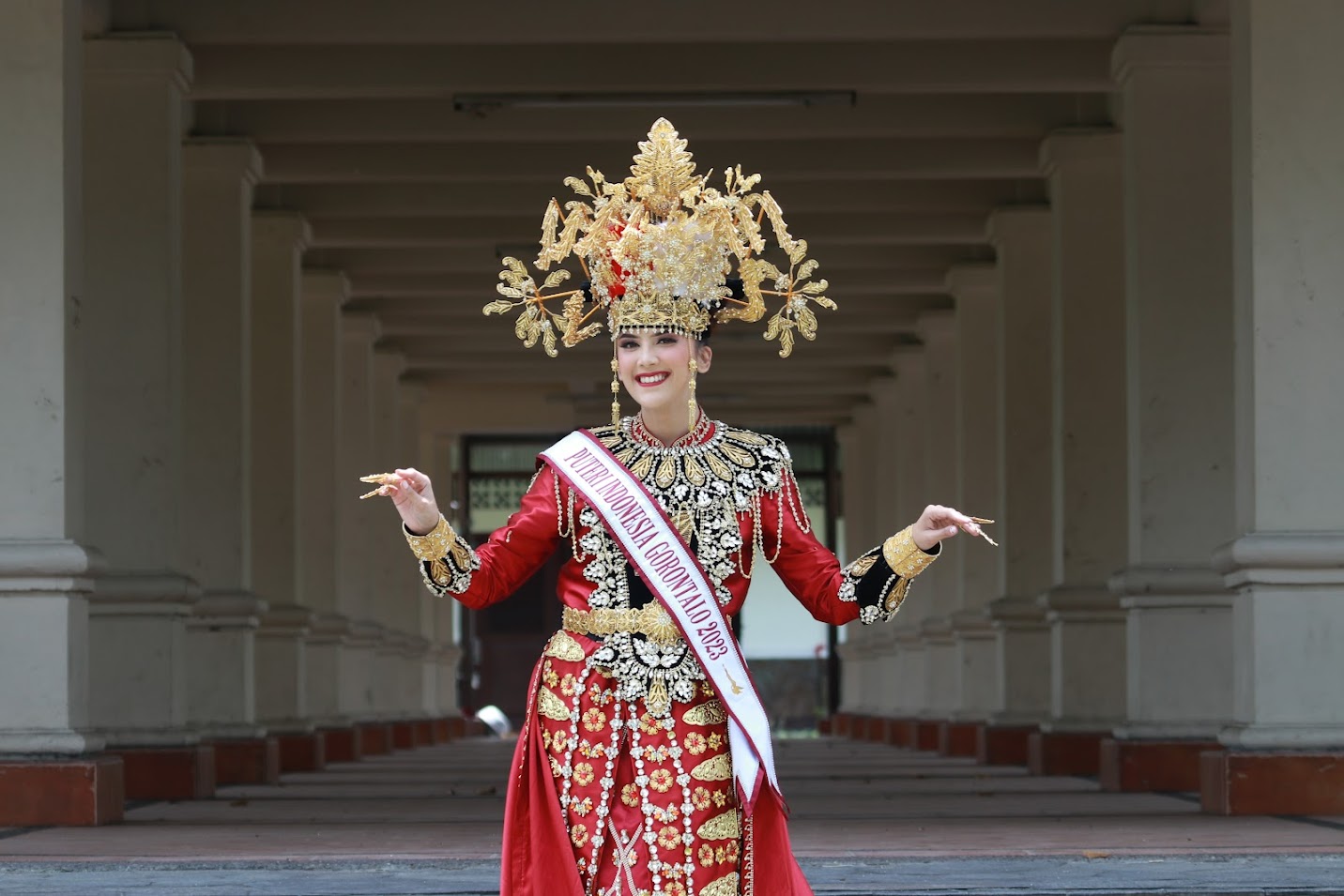
Women in Gorontalo wear Biliu, typically made from materials in colors like green, gold, or purple. They also have a unique decorated garment known as lotidu, specially made with intricate embellishments.
The people of Gorontalo have preserved and upheld their traditional attire for many years.
2.4 Traditional Clothing of Yogyakarta
Yogyakarta is renowned as a center of classical Javanese art. Therefore, traditional clothing in this city not only reflects aesthetics and culture but also demonstrates respect and preservation of local traditions.
For men in Yogyakarta, traditional clothing typically consists of a jacket, long pants, and shoes. The jackets are usually wide and standing, accompanied by accessories like buttons and zippers. The pants are also designed to be comfortable and come with various accessories like belts, socks, and hats.
There are no specific traditional clothing requirements for women in Yogyakarta. However, their daily attire is often made from batik fabric, a characteristic Indonesian textile, combined with handmade accessories to enhance their appearance.
Traditional Indonesian clothing for men in Yogyakarta is known for its high aesthetics.
2.5 Traditional Clothing of East Kalimantan
Kalimantan is one of the three largest islands in Indonesia, divided into two distinct ethnic groups: the Dayak people and the Kutai people. This diversity has contributed to the richness of traditional clothing in Indonesia.
For the Dayak people, their traditional clothing includes Ta'a and Sapei Sapaq. These garments are often created using natural resources, combined with the craftsmanship and artistry of the people. Ta'a, in particular, has a head covering made of bird feathers and is adorned with various beautiful jewelry.
The Kutai people have their traditional clothing known as Miskat. This outfit comprises a long shirt and pants made from diverse fabrics and decorated with colorful patterns. Miskat is the most common traditional clothing and has been recognized as the official attire for those serving the government.
Traditional Indonesian clothing is incredibly diverse and rich.
These are the distinctive features of traditional Indonesian clothing. Hopefully, this information will be useful for your travel and exploration of this beautiful and diverse archipelago. Today, visit https://www.vietjetair.com/en/flights/flights-to-indonesia to choose a flight that suits your travel plans. For more travel information and promotions from Vietjet, visit:
- Fanpage: https://www.facebook.com/vietjetvietnam
- Instagram: https://instagram.com/vietjet
- YouTube: https://youtube.com/c/VietjetOfficial
- TikTok: https://www.tiktok.com/@vietjetvietnam
- Zalo: https://oa.zalo.me/vietjet