
Lunar New Year, also called Spring Festival, is not only the moment to welcome the new year but also the most important festival in traditional Chinese culture. With unique customs, rich cuisine, and lively celebrations, Chinese Lunar New Year is an unmissable experience for anyone who loves exploring Eastern culture.
1. General Introduction to Chinese Lunar New Year
Many people wonder, does China celebrate Lunar New Year? The answer is YES. China celebrates Lunar New Year with solemn ceremonies as it is considered the biggest festival in the most populous country.
A new year arrives; join Vietjet to explore New Year in China—the most special holiday of the year for the Chinese people.
1.1 When is New Year in China?
Chinese Lunar New Year usually falls on the first day (1/1) of the Chinese lunar calendar, typically from late January to mid-February in the Gregorian calendar, lasting about 15 days. It is a very important cultural holiday in China, serving as a time for family reunion and praying for luck and prosperity in the coming year.
1.2 Origin of Chinese Lunar New Year
Originally, Lunar New Year in China was not only a time to welcome the new year but also an important ritual to honor gods and ancestors, praying for a peaceful year, good harvest, and abundant life. According to historical records, Lunar New Year may have originated during the Shang dynasty (circa 1600–1046 BCE). At that time, people believed that gods and ancestors had great influence over life. At the beginning of each year, people held offerings to express gratitude and ask for protection from supernatural forces. During the Zhou dynasty (1046–256 BCE), Lunar New Year gradually became a holiday symbolizing reunion, where family members gathered, remembered ancestors, and welcomed spring together. The term “Yuan Dan” appeared in the Han dynasty (206 BCE – 220 CE), when the emperor designated the first day of the lunar calendar as the start of the new year. “Yuan” means “beginning,” and “Dan” means “morning.” Hence, Chinese Lunar New Year symbolizes the start of a new cycle filled with hopes and dreams.
1.3 Importance of New Year in China
Today, Chinese Lunar New Year retains its core value as a time for family reunion and ancestor remembrance. It is not only the largest holiday but also holds profound spiritual and cultural significance. However, with societal development, many customs have been modernized or blended with contemporary elements. Lunar New Year is not only a cultural festival but also a time to promote China’s image worldwide. It has gradually become an important cultural and spiritual symbol of the Chinese people and a grand festival attracting international attention.
See more: Summary of countries that celebrate Lunar New Year — Where to go?
2. Traditional Customs during Chinese Lunar New Year
2.1 Posting Door Gods
Chinese people often paste images of two Door Gods, based on the legend of two brothers, Shen Tu and Yu Lei, gods who guard doors to ward off evil spirits and protect the family. These posters are vividly designed to pray for peace and safety.
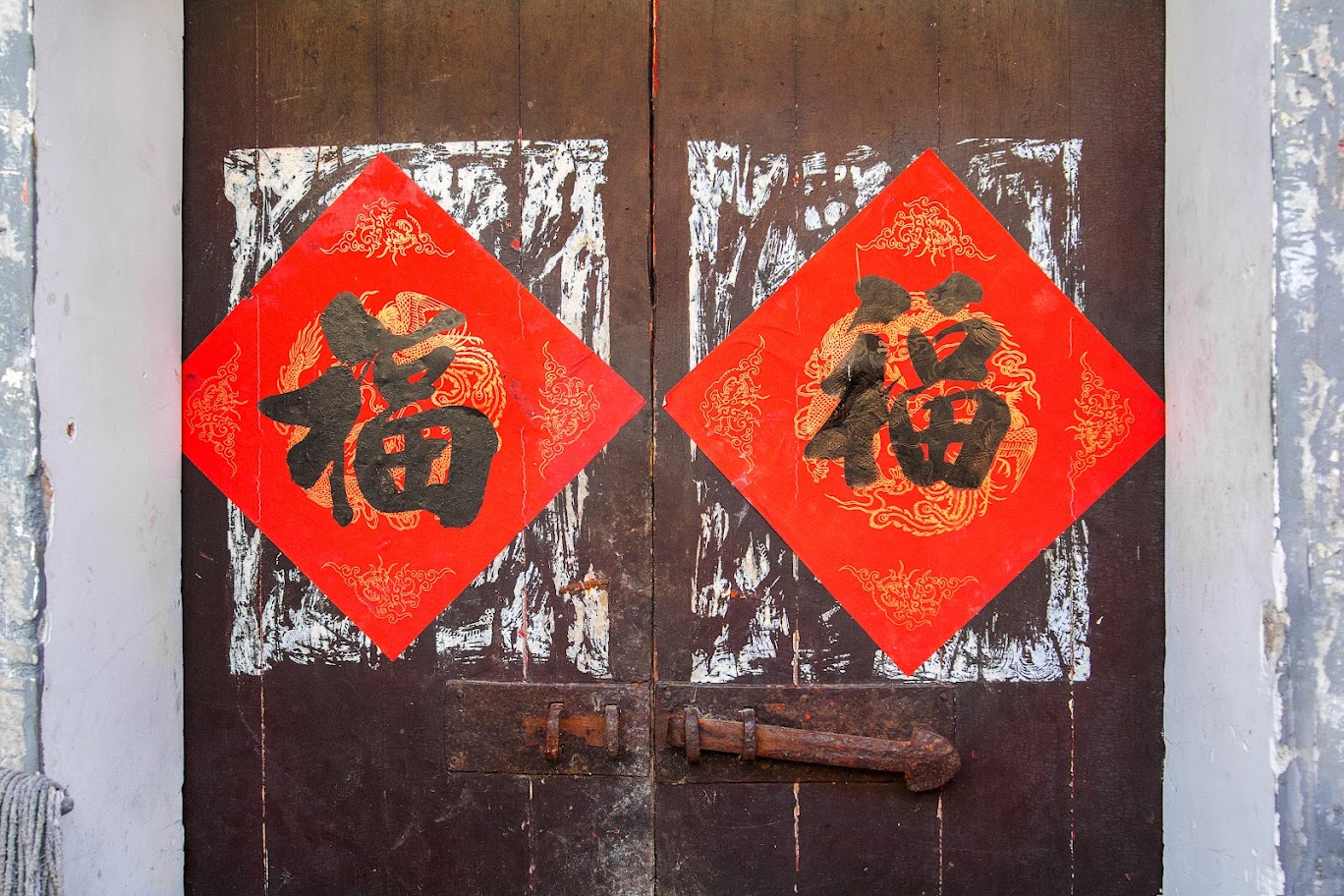
2.2 Hanging Upside-Down “Fu” Character
The “Fu” character (meaning “fortune”) is hung upside down to symbolize “Fu Dao,” meaning “fortune arrives.” This custom expresses the wish for luck and prosperity in the new year. The “Fu” character is usually red, symbolizing happiness and good fortune.
The custom of hanging the upside-down "Fu" character on doors during Chinese Lunar New Year symbolizes blessings and good luck arriving at home in the new year.
2.3 Red Envelope (Hongbao)
The red envelope containing money, known as Hongbao, is a symbolic gift of blessings. The money inside is usually an odd number, symbolizing luck. During the New Year, elders give red envelopes to children with wishes for luck and success. Nowadays, the custom has expanded to include giving red envelopes to elders, parents, friends, colleagues to express affection and good wishes for the new year. Giving red envelopes is not only a spiritual gesture but also a beautiful cultural tradition of the Chinese people that deserves to be preserved and promoted.
3. Typical Foods during Chinese Lunar New Year
3.1 Nian Gao (New Year Cake)
Nian Gao is an indispensable dish during Chinese New Year, symbolizing “progress year by year.” It is made from glutinous rice, sugar, and ginger, sweet and golden, symbolizing wealth, prosperity, and abundance.
Nian Gao during Chinese Lunar New Year is sticky, sweet, and fragrant, symbolizing reunion and prosperity in the new year.
3.2 Longevity Noodles
Longevity noodles are long, uncut noodles symbolizing long life and health. This dish is often eaten on New Year’s Day, wishing for a vigorous year. Common noodle dishes include stir-fried noodles, noodle soup, and mixed noodles.
3.3 Eight Treasures Rice (Babao Fan)
Eight Treasures Rice is sticky rice cooked with eight kinds of nuts and dried fruits, symbolizing wealth and fullness. The harmonious colors and flavors evoke joy and reunion.
See more: Chinese Cuisine: Explore 8 Local Culinary Schools
4. Special Festivals during Chinese Lunar New Year
4.1 Lantern Festival
The Lantern Festival occurs on the 15th day of the first lunar month during Chinese New Year. People release sky lanterns, join games, and enjoy a vibrant festive atmosphere.
The Lantern Festival during Chinese Lunar New Year shines with thousands of colorful lanterns symbolizing hope and new beginnings filled with light.
4.2 Lion and Dragon Dances
Lion and dragon dances symbolize driving away evil spirits and praying for wealth. These spectacular performances attract large crowds with booming drums and cymbals.
Lion and dragon dances during Chinese Lunar New Year are brilliant and lively, symbolizing luck and prosperity for the new year.
4.3 Fireworks Display
Fireworks are an indispensable activity during Chinese New Year, lighting up the night sky and creating a joyous atmosphere. Fireworks not only create a beautiful scene but also symbolize driving away evil spirits and welcoming a hopeful new year.
The fireworks festival during Chinese Lunar New Year is colorful, symbolizing warding off evil and welcoming a lucky new year.
5. Travel Tips for China during Chinese Lunar New Year
5.1 Easy Travel with Vietjet
Vietjet offers many direct flights to major Chinese cities such as Beijing, Shanghai, Guangzhou, making it easy for travelers to explore Chinese Lunar New Year. Especially, if you plan to travel during Chinese Lunar New Year, don’t miss Vietjet’s early sale of 2.6 million domestic and international tickets at preferential prices starting from only 890,000 VND. Moreover, you can hunt for 0 VND tickets daily between 12-14H to optimize travel costs. Book now to select your preferred flight times!
Explore Chinese Lunar New Year with Vietjet at super preferential costs!
5.2 Best Time to Travel
The ideal time to visit China during Lunar New Year is from the 28th day of the 12th lunar month to the 15th day of the first lunar month, when festive atmosphere fills everywhere.
5.3 Appropriate Clothing
During New Year, China is often cold with snow in some areas. Travelers should prepare warm clothes, anti-slip shoes, and thermal accessories to enjoy the trip fully.
See more: Self-Guided China Travel Tips for Non-Chinese Speakers
This article has helped answer the question “Does China celebrate Lunar New Year?” Chinese Lunar New Year is the biggest festival of the year, rich in cultural and spiritual value. With unique customs, special cuisine, and dazzling festivals, it is a memorable experience for anyone who loves to explore. Join Vietjet to start the new year with a joyful journey in China!
Learn more attractive offers and useful travel information at:
- Facebook: https://www.facebook.com/vietjetvietnam
- Instagram: https://instagram.com/vietjet
- YouTube: https://www.youtube.com/VietjetOfficial
- TikTok: https://www.tiktok.com/@vietjetvietnam
- Zalo: https://oa.zalo.me/vietjet